


Aida Count Matters More Than You've Thought
- Polina Gorokhova

- Apr 19, 2020
- 2 min read
The most obvious thing Aida count stands for is the number of squares, and that means stitches, in one inch of the fabric. So, the 100x140 sized in stitches project will be about 7.14x10 inches large on Aida 14 ct, and 5.55x7.78 inches large on Aida 18 ct. Certainly, this fact is ONE of the most important about fabric count. But 'one of' means 'not only one'.
There are more important things a stitcher and a cross stitch pattern designer should take into account when picking up the fabric count. I will name two more facts: 1) the count stands for the coverage of the fabric; 2) the colour visual mixing depends on count too. Let's look at both fact more close now. Of course, everything works the same for the evenweave or linen fabric.
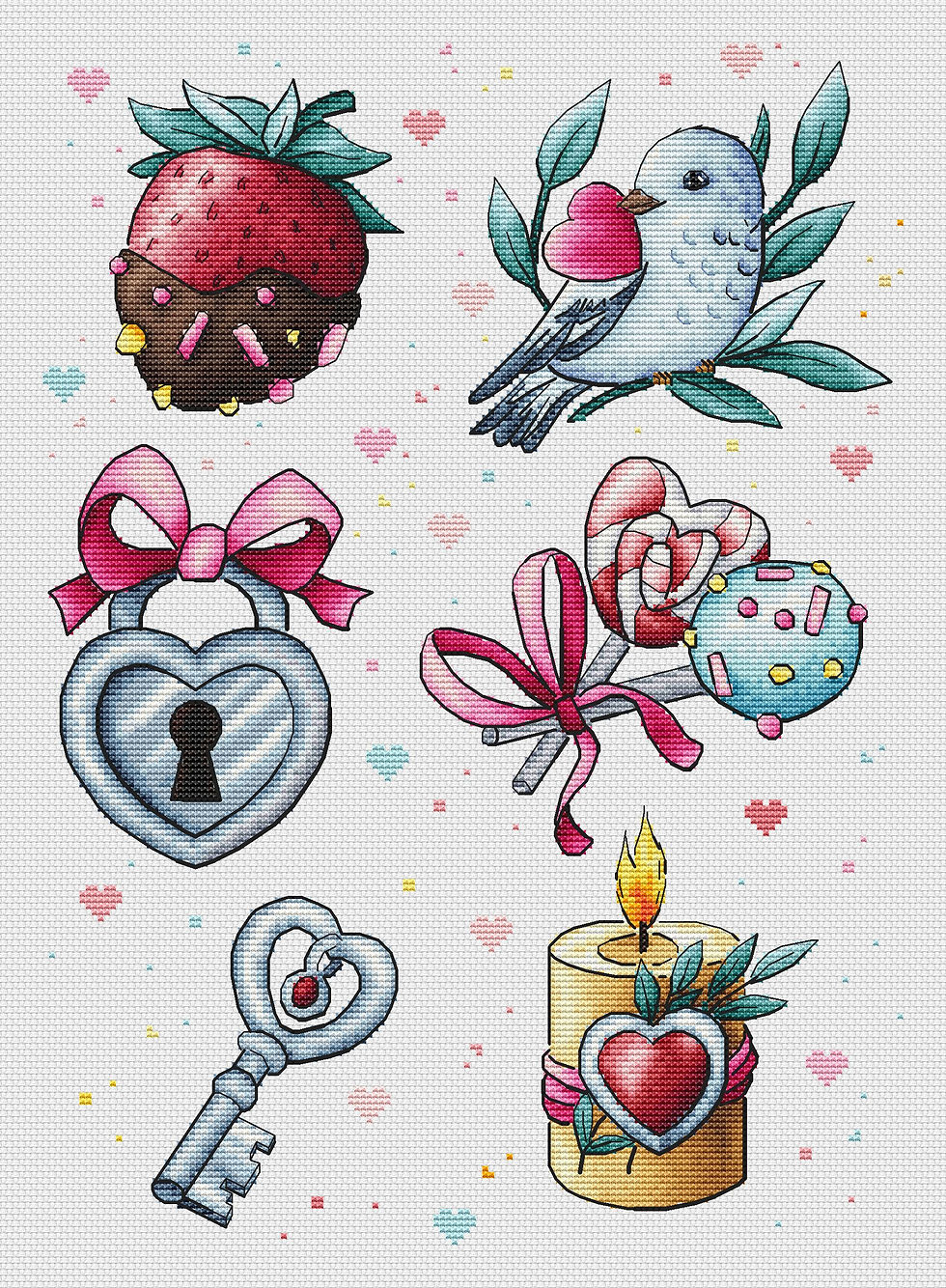
When you stitch, the floss is covering the fabric, but in most cases you can still see some tiny patches of fabric behind the stitches. Of course, this depends both on the fabric count and the amount of strands you use. But most often the designers recommend taking 2 strands, and on Aida 14 ct it will look pretty different from what will be on Aida 18 ct. So if you feel distressed by those nasty fabric patches sticking out from behind your cross stitches, better pick up fabric with smaller squares or use more strands (3 or 4 instead of 2). In the pics bellow you can see the difference: the first stitchery is made on Aida 14 ct and the second on Murano 32 ct, which is evenweave alternative to Aida 16 ct. The threads cover 32 ct/16 ct better.

The visual colour mixing is something more complexed to be explained in few words. The thing is, our eye tends to 'mix' similar colours, so they look pretty much alike to us. This effect is well-known in fine arts and was widely used by some artists: for example, they took different shades of blue, green and violet, but the result looks like 'blue' to us, and only careful look can help to distinguish many shades. It's quite the same for the threads. What's more, colours can influence each other, so some yellow put near to green seems yellowish-green to us. I hope the idea is clear now.
And the smaller your fabric count is (which means larger number), the more distinctive colours are. It happens because the density of the colour on a small patch of the fabric is higher in this case. This is an important point about cross stitching. If you use 14 ct fabric, it can work pretty good with quite distant shades of some colour to give a smooth colour changing, but the same shades can look too rough and too much appart from each other on 18 ct. I intend to develop this particular topic in my future posts, so keep with me if you are interested!
Hope this small article was useful for you! Stitch with pleasure and mind your fabric count!



Comments